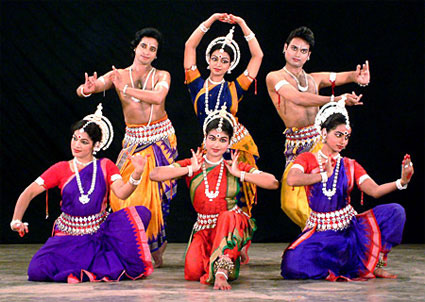
Bharatnatyam is an Indian classical dance form that was earlier performed by Devdasis. Trace the popularity and revival of this classical dance form.Bharatnatyam is a popular Indian classical dance form that has its origins in Thanjavoor, Tamil Nadu. Hundreds of years ago this dance form used to be performed by
Devdasis and hence it was earlier called as
Daasiyattam. The dance form got the name later when exponents conceived it as an amalgamation of its components like the
Bhava,
Raga and
Taal. The current Bharatnatyam as a dance form is regularised systematically by the revered Thanjavoor Brothers, Chinnaya, Ponanayya, Shivanandam and Vativelu.
As a classical dance form,
Bharatnatyam has adherence to the Natya Shastra where it distinctly manifests the following forms that conform to the dance style:
- Bhagavata Melam – This is a dance drama form where the themes are based on the Hindu Mythology.
- Sadir Natyam – This is a solo dance form that originally used to be performed by the Devdasis in the temples of Tamil Nadu and also in the royal courts of the Kings of southern India.
- Kuchipudi – This is a derivative of the Bharatnatyam dance form, which is usually presented as dance drama. It has its origins in Andhra Pradesh and also has the themes based on mythological tales. The roles are usually performed by men, but currently since a few decades, women have also taken into performing Kuchipudi.
- Kuravanji – This is a group dance that is solely performed by women, which interprets poetic or literary compositions. The themes are usually based on the fulfilment of the woman’s love for her beloved.
Even Mohiniattayam and Yakshagana dance forms are believed to have their origins in Bharatnatyam, but they are not considered to be firmly rooted in Bharatnatyam as the ones mentioned in the bullets.
Origins of Bharatnatyam
As mentioned earlier Bharatnatyam was originally performed by
Devdasis and was known as
Dasiattayam. It was also known as
Sadir Natyam or
Sadir or
Chinna Melam.
Sadir used to be performed in the courts while
was believed to be an exalted form, that was performed by
Devdasis, who were artists dedicated solely to the services of the temples. Their performance used to be an integral part of the ritual worship for
Pujas and invoking the deities. The royal patronage through the ages supported this dance form. Bharatnatyam also underwent evolution and changes, in its recital mainly during the late 18th century, by the Thanjavur quartet, who were the sons of Nattuvanar Subbarayan, names as Chinnaya, Ponnayya, Vadivelu and Sivanandam. Then Muthuswamy Dikshitar further refined the music and what we currently find Baratnatyam, is basically an evolved Sadir dance form.
Revival of Bharatnatyam
During the British rule,
Dasiattayam was propagated to be immoral and crude and was lawfully banned. But many
Devdasis preserved the tradition in their families and we are indebted to their dedication, else the dance form would have been lost. E. Kriskna Iyer performed the dance in female costume to remove the stigma associated with it and he was also a freedom fighter. He was eventually one of the founders of the music Academy of Chennai and the performance on stage attracted controversy and applause equally. Later Iyer asked the legendary dancer Rukmini Devi to learn Bharatnatyam and perform it on stage. Her debut performance was a milestone in 1935 and resulted in the current popularity with time.
The Subsequent Changes in Bharatnatyam
The dance form had been revived in the 1930s and today there is a significant change in the Bharatnatyam style. So long Bharatnatyam was a part of the religious and social life of the people of Tamil Nadu predominantly, and it was flourished and preserved with royal patronage. Gradually, as the popularity increased the demand for learning the art form began to exceed the infrastructure and it became difficult to maintain the traditional standards.
Earlier the Nattuvanars or Gurus were sole custodian of this dance form. Today we have experienced dancers who act as teachers, and it is now learnt in institutions like the Kalakshetra, and even privately as tuitions. So changes have followed due to the loss of integrity and lineage. There have been unrestrained innovations and variations that are not very well received by the strict exponents of Bharatnatyam. But the form is already in the flux of change due to demand and acceptance of variations by the audience.
The performance comprises of three components: the
Natyam,
Nritham and
Nrityam. The
dance style is based on the theories of primarily two books namely,
Natyashastra and
Abhinaya Darpanam. The steps are known as
Adavu and the hand gestures are called Hastramudra. There are 64 basic steps or Adavu, which are classified into 9 categories. The most prominent amongst those are
Mandiadavu, Naatadavu, Kuthithumettadavu,
Sarikkal,
Thattadavu and
Thattumettu. The performer finds expression through
Bhavabhinaya, the facial expressions and
Hastramudra. The performer always begins with
Ganesh Vandana and worship of the
Nataraj Moorthi on stage.
The sequence to the performance can be anything from the
Alarippu, Jathiswaram, Shabdam, Varnam, Padam, and
Thillana. Thillan is the last sequence and the performance concludes with the
Mangal Shlokam. An average performance lasts for around a couple of hours.
The Costume and Music
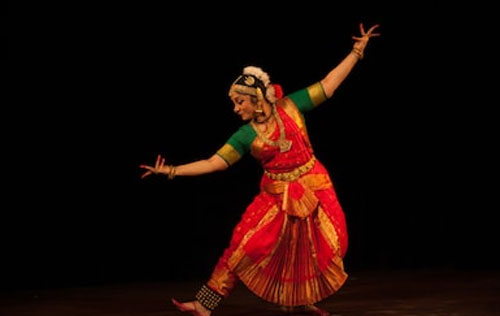
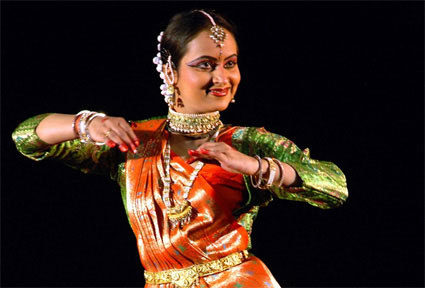
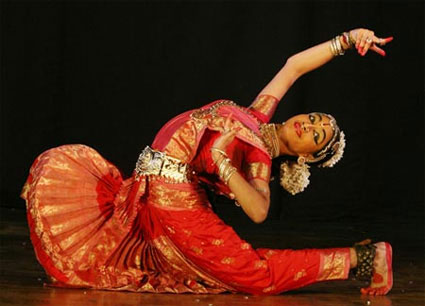
The Bharatnatyam dancer wears a specially designed and tailored jacket or blouse and a pyjama. They are made of Banaras silk or other silks. They adorn themselves with a lot of ornaments of gold, and stones on their ears, head, neck, arms and hands. They also wear
Ghungroos and anklets with small bells and jasmine flowers on their head.
Earlier it used to be an essentially a live performance, but currently dancers perform to pre-recorded recitals. It is always the Carnatic classical music, where the principle instruments used are the flute, Mridangam, violin and Veena. Ideally one has the
Nattuvanar directing the recital providing the
Thaalam, using his hand symbols and singing the
Vaaythari. The Bharatnatyam owes its popularity to noted dances like Rukmini Devi, Balasaraswati, Kamala Laksman, Mrinalini Sarabhai and Chithra Viweswaran. Some of famous Nattuvars of recent times were Padmasree Vazhoor Ramayyan Pilla, Meenakshi Sundaram Pilla, and Adayar Laxman.
How long does it take to learn Bharatnatyam? What is the right age for kids to start learning Bharatnatyam? Who are famous Bharatnatyam dancers in India who helped in its revival? Discuss here.